FANUC Series16/160i-LB,LPB Pulse Power Feedback by Actual Power Presumption Method, Specifications Additional Manual Page 15
Additional Manual
A-78991E
Edit
Apprv.
Desig.
Sheet
Title
Draw
No.
Date
Design
Descri
p
tion
Date
FANUC Series 16/160i –LB,LPB
Pulse power feedback by actual power
presumption method
2002.11.20
14/14
Sheet Sheet
M.Sato K.Suzuki
03 2003.05.27 M.Sato
Section 3,4,6 has been changed, Section 9 has been added.
04 2003.07.10 M.Sato Section 4 has been added.
05 2003.08.06 M.Sato Section 5,6 has been changed.
06 2004.01.27 M.Sato Section 1,6 has been changed.
07 2004.10.21 M.Sato Section 4,8 has been changed.
08 2005.10.20 M.Sato Section 8 has been changed.
09 2005.11.08 M.Sato Section 5 has been changed.
9 Signal
- Power sensor time constant measure signal
PTCMR<G488#1>
[Classification] Input signal
[Function] The time constant measurement of the power sensor starts.
[Operation] When rising of this signal is detected, CNC starts the time constant
measurement of the power sensor.
If this signal becomes 0 while measuring it, the measurement is discontinued.
- Power sensor time constant measure-in- process signal
PTCMM<F488#3>
[Classification] Output signal
[Function] This signal notifies measuring the time constant of the power sensor to PMC.
[Output condition] CNC makes this signal "1" while measuring the time constant of the power
sensor.
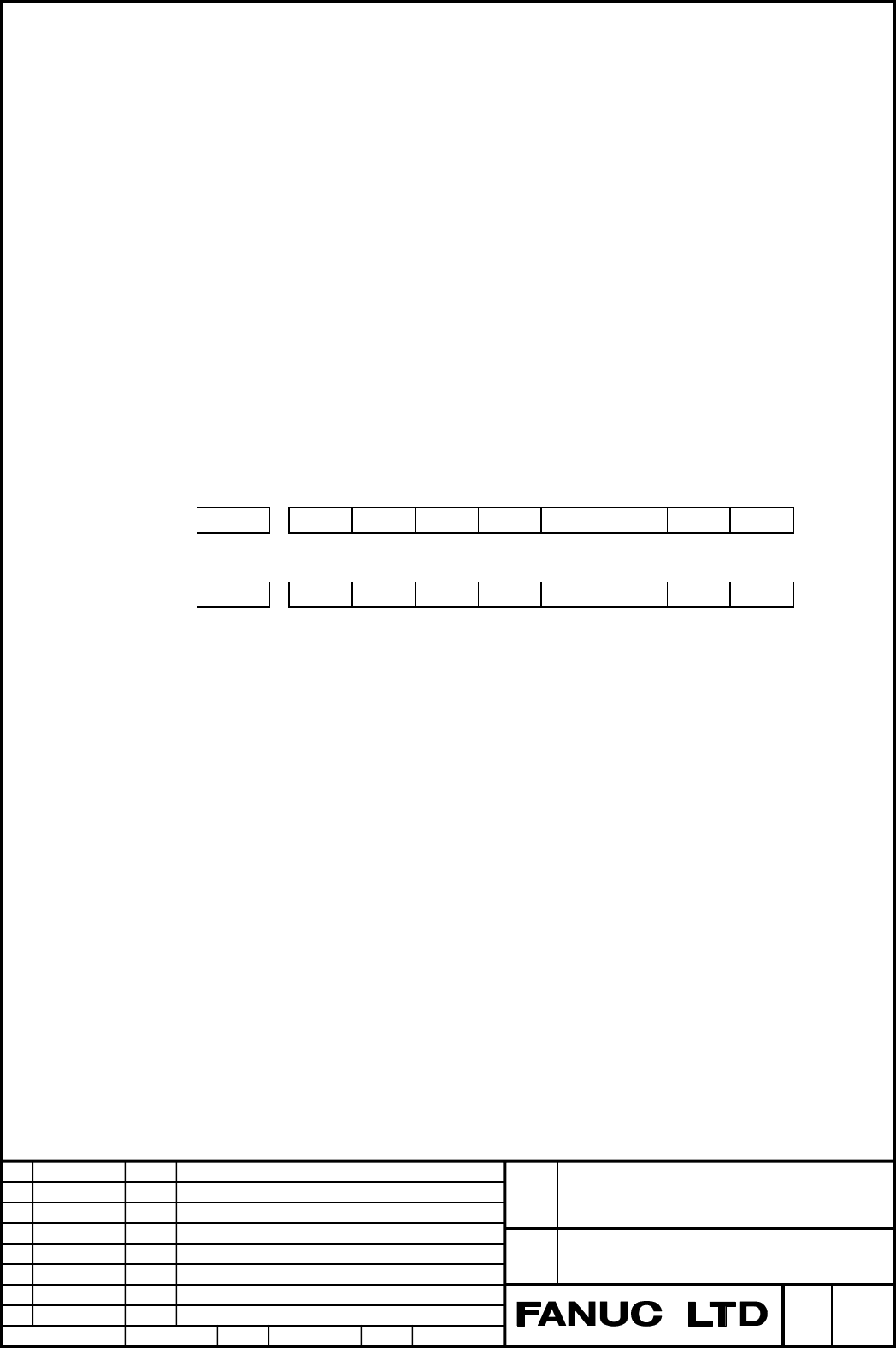
#7 #6 #5 #4 #3 #2 #1 #0
G488 PTCMR
#7 #6 #5 #4 #3 #2 #1 #0
F488 PTCMM
10 Notes
When the pulse wave is output with the trigger pulse being effective, the Pulse ON or OFF
time shorter than 50 microseconds cannot be commanded.
If the Pulse ON or OFF time shorter than 50 micro seconds is commanded, the Pulse ON or
OFF time is clamped at 50 microseconds.
In this case, the pulse width is adjusted by not the pulse frequency but the pulse duty.
For instance, Pulse OFF time is calculated 25 microseconds in case of commanding
Frequency 2KHz and duty 95%.
However, Pulse OFF time is output 50 microseconds (=duty 90%) actually.
Contents Summary of FANUC Series16/160i-LB,LPB Pulse Power Feedback by Actual Power Presumption Method, Specifications Additional Manual
- Page 1TECHNICAL REPORT NO.TML 05/029E Date. Nov. 08, 2005 General Manager of Laser Laboratory Pulse power feedback function 1. Communicate this report to: ○ Your information only ○ GE Fanuc-A, GE Fanuc-E FANUC Robotics MILACRON ○ Machine tool builder Sales agency End user 2. Summary for Sales Documents 3.
- Page 2FANUC Series16/160i-LB,LPB Pulse power feedback by actual power presumption method Specifications Copyright 2005 FANUC LTD. 09 2005.11.08 M.Sato Section 5 has been changed. FANUC Series 16/160i –LB,LPB 08 2005.10.20 M.Sato Section 8 has been changed. Title Pulse power feedback by actual power 07 2
- Page 31 Outline This function presumes the actual power based on the commanded beam condition with a data table that registers the relation between the commanded beam condition and the actual power and executes the feedback control aiming at the presumption value. It is necessary to register the data tabl
- Page 4(1) Command peak power [Data type] Word [Data unit] W [Data range] 0~7000 The command peak power on each data table is set. (2) Command frequency [Data type] Word [Data unit] Hz [Data range] 0~2000 The command frequency on each data table is set. (3) Command duty [Data type] Word [Data unit] % [Data
- Page 5This screen can be displayed according to the following orders. (1)Set 1 to parameter MNT (PRM No.15160#0). (2)Set 1 to parameter PTB (PRM No.29000#1). (3)Push the MDI key "OFFSET" several times, and the laser screen is displayed. (4)Push the right edge soft key (continuance menu key), and the page
- Page 610.4-inch monitor 7.2-inch monitor 09 2005.11.08 M.Sato Section 5 has been changed. FANUC Series 16/160i –LB,LPB 08 2005.10.20 M.Sato Section 8 has been changed. Title Pulse power feedback by actual power 07 2004.10.21 M.Sato Section 4,8 has been changed. presumption method 06 2004.01.27 M.Sato Sect
- Page 75 Data input and output Data can be saved by using memory card or reader/puncher interface (RS232C). Moreover, the saved data can be read into CNC. Selection at output destination and setting of communication condition should be specified by the parameters concerning an external I/O device. Refer to
- Page 82. Input of the data For the data table screen for the actual power presumption (1)Make sure the input device is ready for reading. (2)Set the operation mode of the CNC to EDIT. (3)When using a floppy, search for the required file. (4)Display the Actual power presumption table screen. (5)Push soft k
- Page 96 Compensation to response speed of power sensor The power feedback control is controlled by the deflection between the command power and the monitor value of the power sensor. The deflection increases in transitional state because the power sensor cannot follow changing command power, if the power
- Page 10The internal electrical discharge can be executed in case of filling the bellow conditions. Present state of the conditions can be confirmed on the time constant measurement screen. (1)The laser sequence number (DGN No.908) is 30. (2)The shutter lock is effective. (3)The shutter is shutting (4)The b
- Page 11The time constant measurement screen 7 Bell shape type filter applied to power feedback gain The response delay of the power sensor is compensated by filtering a presumption power. However, the laser power is changed by the influence of the power feedback at the switch of the command power in case t
- Page 128 Parameter #7 #6 #5 #4 #3 #2 #1 #0 29000 PTC PTB PFB PFB Pulse power feedback by actual power presumption method is : 0: Disabled 1: Enabled PTB Actual power presumption table screen is : 0: Disabled 1: Enabled When this parameter is 0, the screen is not displayed and data cannot be input. Set 0 no
- Page 1329003 Peak power when power sensor time constant is measured [Data type] Word [Data unit] W [Data range] 0~7000 The peak power when the time constant of the power sensor is measured is set. Set the rated power of the oscillator. 29004 Beam output time when power sensor time constant is measured [Dat
- Page 1429011 Model to which data table is applied [Data type] Word [Data unit] [Data range] 0~32767 Set the oscillator model of the registered data table. Set the model name represented by A-Z of alphabet with being replaced with numeral. For instance, A is 1 and E is 5. This parameter is set when CNC is s
- Page 159 Signal - Power sensor time constant measure signal PTCMR