FANUC Series 16i-MA Synchronous Control between 2 Path Additional Manual Page 8
Additional Manual
FANUC LTD
ED
DATE
DESCRIPTION
D
ESIGN
FANUC Series 16i-MA
SYNCHRONOUS CONTROL BETWEEN 2 PATH
A-76311EN
01
990809
TAKEUCHI
New registration
7
/30
TAKEUCHI
4. Signals
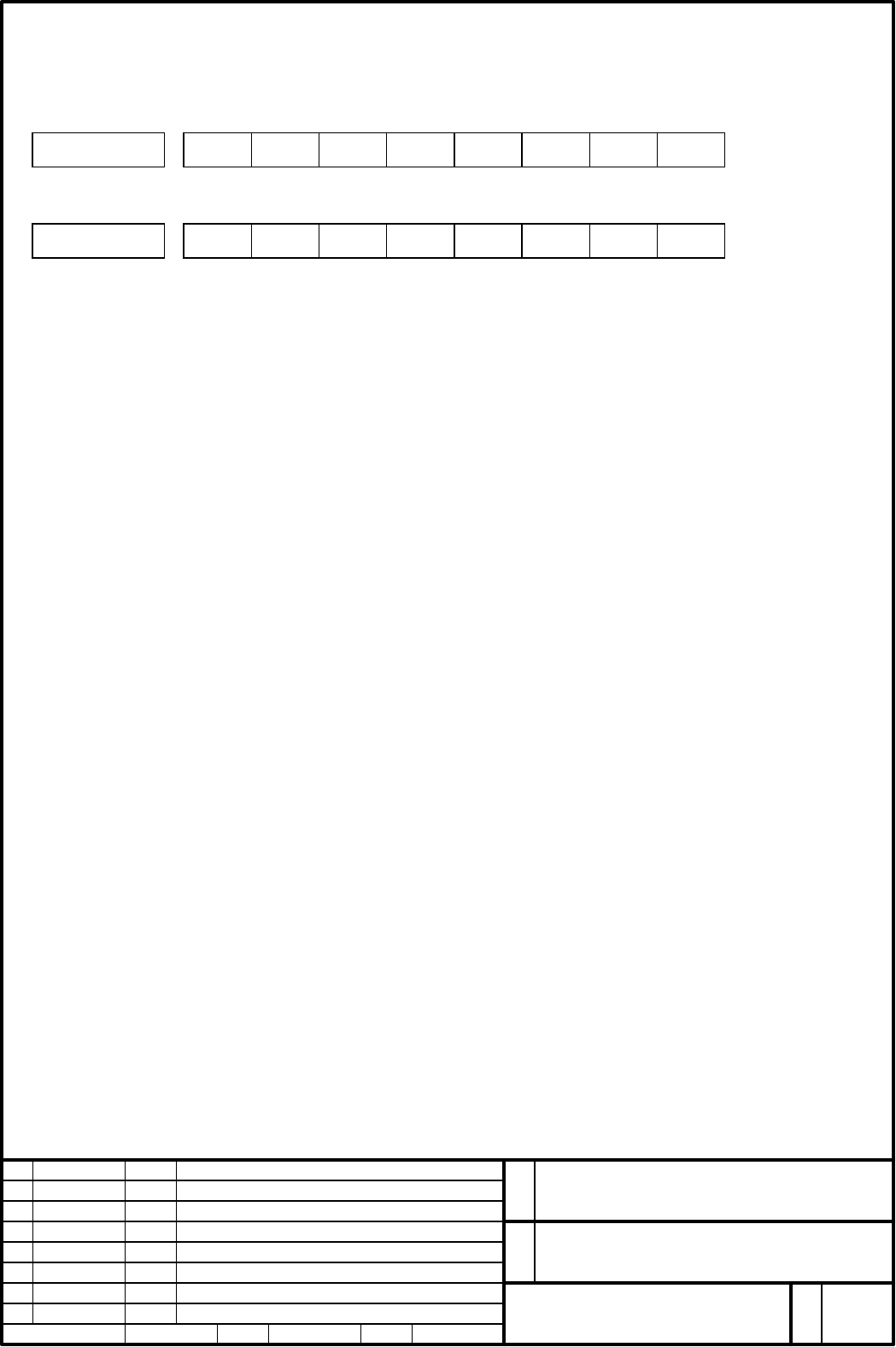
#7 #6 #5 #4 #3 #2 #1 #0
G0138/G1138
SYNC7 SYNC6 SYNC5 SYNC4 SYNC3 SYNC2 SYNC1
#7 #6 #5 #4 #3 #2 #1 #0
F0118/F1118
SYN7O SYN6O SYN5O SYN4O SYN3O SYN2O SYN1O
Synchronous control selection signal (input) SYNC1,SYNC2,SYNC3,...,SYNC7
<G0138/G1138#0,#1,#2,#3,...#6>
To turn this signal to HIGH from LOW starts synchronous control of corresponding
axis.
The axis set in parameter No.8180 is made the master axis. However, when a
setting value of parameter No.8180 of corresponding axis is 0, even if this
signal is risen, the synchronous control will not be performed. To turn this
signal to LOW from HIGE during synchronous control release synchronous control
of corresponding axis.
Synchronous control state signal (output) SYN1O,SYN2O,SYN3O,...,SYN7O
<F0118/F1118#0,#1,#2,#3,...#6>
This signal (both F0118 and F1118) become HIGH when the corresponding axis is
under synchronous control state. This signal become LOW when the corresponding
axis is not under synchronous control state. The controlling state of
synchronous is not always same as the signal state of Synchronous control
selection signal(SYNCn). For example, it is not effective to rise SYNCn, under
alarm state. Moreover, when the servo alarm is detected during synchronous
control, synchronous control will be automatically released. When synchronous
control is performed, it is necessary to confirm the state of this signal.
Moreover, please judge the synchronous control selection signal and this signal
by doing the AND logic to confirm the state of the synchronous master axis.
Contents Summary of FANUC Series 16i-MA Synchronous Control between 2 Path Additional Manual
- Page 1FANUC Series 16i-MA SYNCHRONOUS CONTROL BETWEEN 2 PATH Specifications The number and the name of the content of the specification and the parameter in this specifications have the possibility to become a change. 1. Overview ............................................................................
- Page 21. Overview FANUC Series 16i-MA(The following are abbreviated with 16i-MA) of two path builds two independent path and is used for the usage in which two tools of the machining center are controlled independently. (These two path are usually called PATH1 and PATH2. It is written in this specificatio
- Page 32.3 Signal operation Set synchronous control selection signal, G0138/G1138 #0-#6 SYNC1-SYNC7, as "1" from "0" (when beginning synchronous), as "0" from "1" (when releasing synchronous) by PMC. Please begin a synchronous signal in one PATH after always releasing a synchronous signal in the other PATH
- Page 42.6 Synchronous error detection The synchronous control here indicates the same to the last movement command is given to two servo processing systems at the same time. Synchronous error compensation, detecting the deflection of two servo motors always and compensating one servo motor to reduce the d
- Page 52.8 workpiece coordinate system Please do the change (change the workpiece zero point offset value of G54, G55,...G59 by G10) in the coordinate system when you release a synchronous control. However, when the coordinates values of the synchronous control axis are the same is possible. P/S alarm 226
- Page 63. Parameters #7 #6 #5 #4 #3 #2 #1 #0 8160 NRS NCS Data format : Bit type NCS When the axis of synchronous control becomes overtravel alarm, 0:Synchronous control are released. 1:Synchronous control are not released. (note) When the axis which execute synchronous control becomes overtravel alarm, th
- Page 7(example 1) When X2 axis is synchronized with X1 axis PATH1 PATH2 parameter №8180x 0 parameter №8180x 1 parameter №8180y 0 parameter №8180y 0 parameter №8180z 0 parameter №8180z 0 parameter №8180b 0 parameter №8180b 0 (example 2) When X1 axis is synchronized with X2 axis When X2 axis is synchronized
- Page 84. Signals #7 #6 #5 #4 #3 #2 #1 #0 G0138/G1138 SYNC7 SYNC6 SYNC5 SYNC4 SYNC3 SYNC2 SYNC1 #7 #6 #5 #4 #3 #2 #1 #0 F0118/F1118 SYN7O SYN6O SYN5O SYN4O SYN3O SYN2O SYN1O Synchronous control selection signal (input) SYNC1,SYNC2,SYNC3,...,SYNC7
To turn this signal to HIGH f - Page 95. Remarks (1) The controlled axis must stop at beginning or releasing synchronous control. (2) Two or more axes can be put into the state of synchronous control at the same time. However, following operations are impossible. To synchronize a axis with multiple axes. (3) Least command increment and
- Page 10(10) When operations, by which machine is not moved but work coordinate system is changed, such as work coordinate system setting is performed in the synchronous master side path, the operations is not effective to the work coordinate system of the synchronous slave side path. (11) When cutter compe
- Page 11(15) When M code of a synchronous beginning/release is made set none-buffering M code, you can make program which you neglect the limitation of the preprocessing. (16) Please begin a synchronous signal in one PATH after always releasing a synchronous signal in the other PATH when synchronous control
- Page 125.1 Restriction ○:Standard ●:Standard option ☆:Option *:Function included in another option −:Impossible △:Impossible during synchronous control Note) Some combinations of these option are restricted Item Specifications 16i-MA 2PATH Axis control by PMC Max .simultaneous 4 axes per − path (Not availa
- Page 13Inch / metric conversion ☆ △ (B) Interlock All axes/each axis/cutting ○(2) block start Machine lock All axes/each axis ○ (1) Emergency stop ○ Overtravel ○ Stored stroke check 1 ○ (3) Stroke limit external setting − Stored stroke check 2 ☆ (3) Stored stroke check 3 ☆ (3) Stroke limit check before mov
- Page 14Backlash compensation for each ○ rapid traverse and cutting feed (3) Stored pitch error compensation ☆ (3) Straightness compensation − Position switch ☆ Unexpected disturbance torque ☆ detection function Program restart − Tool retract and recover − Retreat and retry function − Buffer register − Dry
- Page 15Incremental feed ×1、×10、×100、×1000 ○ Jog and handle simultaneous ○ mode Manual numerical command ☆ Positioning G00(Linear interpolation type ○ positioning is possible) Single direction positioning G60 − Exact stop mode G61 ○ Exact stop G09 ○ Linear interpolation ○ Circular interpolation Multi-quadra
- Page 16Skip function G31 ○ (5) High-speed skip function ☆ (5) Continuous high-speed skip − Multi-step skip function ☆ (5) Reference position return G28 ○ Reference position return check G27 − 2nd reference position return ○ 3rd,4th reference position return ☆ Floating reference position − return Normal dir
- Page 17Automatic Rapid traverse : linear ○ acceleration/deceleration Cutting feed : exponential (7) Rapid traverse bell-shaped ☆ acceleration/deceleration (7) Linear acceleration/deceleration ☆ after cutting feed interpolation (7) Bell-shaped ☆ acceleration/deceleration after (7) cutting feed interpolation
- Page 18Feed stop − Advanced preview control − Simple high-precision contour − control High-precision contour control 64-bit RISC(Only for 1 path) − Rotary axis designation ○ Rotary axis roll-over − Polar coordinate command ☆ Coordinate system setting ○ (8) Automatic coordinate system ○ setting (8) Workpiec
- Page 19Addition of custom macro common #100∼#199,#500∼#999 ☆ Variables Macro variables common with For 2 path * both 2 path Pattern data input ☆ Interruption type custom macro ☆ Canned cycles for drilling ☆ Small-hole peck drilling cycle ☆ Canned cycles for grinding For grinding machine − Circular interpol
- Page 20Multiple command of auxiliary 3 ○ function M code group check ☆ Spindle speed function S5-digit,binary output ○ Spindle serial output S5-digit,serial output ☆ Spindle analog output S5-digit,analog output ☆ Constant surface speed control ☆ Spindle override * Spindle speed fluctuation ☆ detection func
- Page 21Tool offset pairs ±6 digit 32 ○ ±6 digit 64 ☆ ±6 digit 99 ☆ ±6 digit 200 ☆ ±6 digit 400 ☆ ±6 digit 499 ☆ ±6 digit 999 ☆ Tool offset memory B Geometry/wear memory ☆ Tool offset memory C Distinction between geometry and ☆ wear, or between cutter and tool length compensation Tool length compensation ○
- Page 22External message ☆ External machine zero point shift ☆ △ External data input Including above 3 items ☆ External workpiece number 15 ○ search External program number search 1∼9999 * Status output signal NC ready, servo ready, ○ automatic operation, (11) automatic operation start lamp, feed hold, rese
- Page 235.2 Reading of coordinates during synchronous control Reading of current coordinates by system variables of custom macro or by PMC window during synchronous control is as follows. Kind of position information During synchronous Control Absolute coordinates Possible to read. Machine coordinates Possi
- Page 245.3 Releasing of synchronous control The synchronous control are released for the following besides the synchronous control selection signal is turned off. (1) Emergency stop (2) Reset (3) Servo alarm (4) Servo off (5) Over travel alarm (6) Alarm concerning synchronous control (7) P/S000 alarm One P
- Page 255.4 State signal of axes during synchronous controls State signal During synchronous control The signal of the master axis becomes "1" while the master axis or Movement state signal the slave axis is moving. Signal of slave axis is always "0". (1) MVn F0102/F1102 Signal of the master axis is a direc
- Page 266. Alarm When the following alarms are issued, synchronous control of all axes will be released. 6.1 P/S alarm Number Content 225 This alarm is issued in the following cases. (When synchronous control command are released, it is detected) (1) When mistake is found in setting parameter of the axis in
- Page 27Supplement 1. Synchronous control Troubleshooting 1. Synchronous control cannot be begun. (Do not become even any alarm) (1) The option of the synchronous control is not set. → It is necessary to option setting to perform synchronous control. (2) The signal of G0138 or G1138 does not stand up. → Syn
- Page 282. When the start signal of synchronous control is turned on, P/S225 alarm is issued. (1) It has tried to use the axis, which is already in synchronous control, for other synchronous control. → One axis cannot be used to combine two or more synchronous controls at the same time. However, only the sy
- Page 294. The P/S226 alarm is generated during synchronous control. (1) The movement command was performed to the synchronous slave axis. → The movement command cannot be performed to the synchronous slave axis regardless of the automatic operation or the manual operation. (2) A value of the selecting work
- Page 307. The movement amount is incorrect while synchronous control. (1) Inch/metric setting is different between the master axis and the slave axis. → Conversion of or inch/metric between the master and the slave are not done in this synchronous control. 8. After the switch of synchronous control, it wil